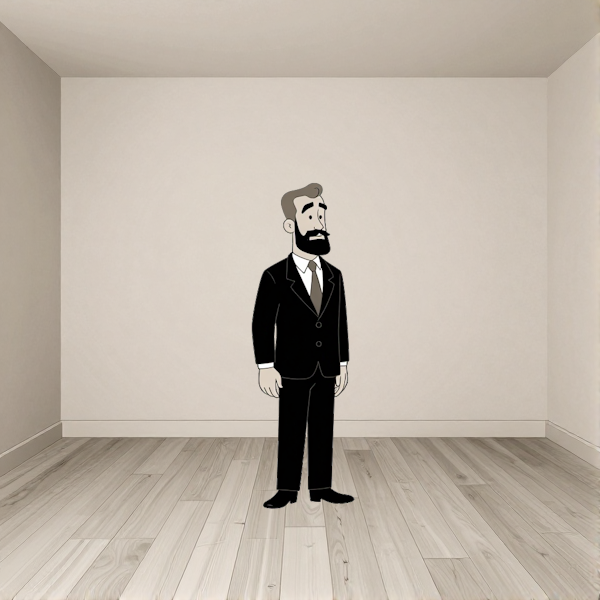
Text to video generation for a cartoon loop of setting someone up for failure. Having just re-read 1984, Flock “license plate” cameras and thoughtcrime were on my mind. Run locally using ComfyUI and MiniMax H3, edited in Shotcut.
For another take on 1984, see the images in 2026 (in the style of 1984).
I wanted the video to loop, so it’s the same sequence twice but with different participant characters so the loop is less obvious.
The joke is that the protestor set up the drivers. Thoughtcrime is having a negative thought against the government, which would be hard to control when so directly steered that way by a protestor’s poster.
Edits#
I started out with a MiniMax H3 workflow in ComfyUI and gave it a basic prompt describing the scenario. I rendered a few copies and saw that this was going to require a much more detailed prompt and the two scenarios were thoroughly confusing the generator. The idea also evolved over time to use Flock drones instead of a futuristic tow truck.
The good thing about the first quick renders is that I could take the parts that I liked like the animated city street render.
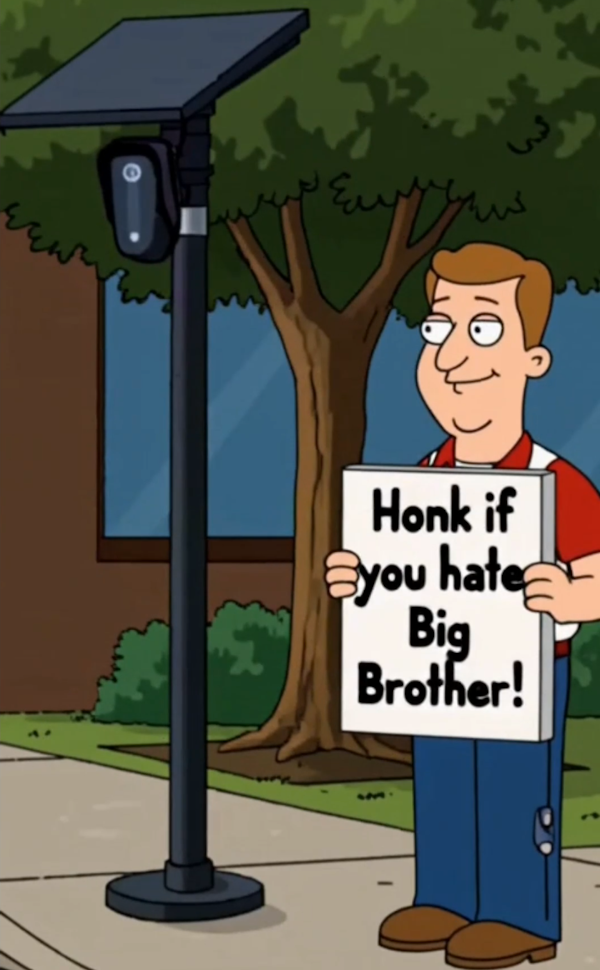
I then used a workflow that allowed reference images. I gave it a screenshot of the city street rendered earlier and a photo of a Flock ALPR camera and then gave it a more detailed prompt. The first few renders continued to have issues.
One of the things that changed frequently was the animated version of the Flock camera. Sometimes, it put a generic security camera on a pole, other times it made the solar panel into the camera. Once it did render it properly, I grabbed that screenshot and replaced the previous reference image. Once the reference was the animated style, it rendered the camera properly each time.
Cleaned up prompting was needed to stop random dialog and get the sequence correct. The streetlight started flashing lights randomly. Every once in a while, the protestor would be in the middle of the street, even though we just saw him on the corner.
One specific problem was the video really liked to honk when the protestor pointed at the camera and I could not get it to stop. Only one render dropped the pointing-honking and the next attempt it returned. I was able to silence the audio track during that time in Shotcut instead of trying to perfect the render.
Rendering the two clips separately and then stitching them together using Shotcut made my finished product.
The Final Video#
White Car Prompt
subject_definitions:
<Subject 1> is the fixed American city intersection environment derived from <Picture 1>. It includes the road layout, white stop line, sidewalk corner, buildings, trees, traffic light, and surveillance pole. Preserve the spatial arrangement, perspective, lighting, and composition of the environment. Traffic signal continuity: The traffic light visible in the intersection must display a steady, solid red light at all times. The red signal remains continuously illuminated in every shot, with no blinking, flashing, yellow, green, or changing signal states. Preserve the same red light state during rack focus, drone arrival, vehicle lifting, and the final empty-intersection shot.
<Subject 2> is the black Flock-style surveillance camera and mounting assembly depicted in <Picture 2>. Preserve its black vertical camera housing, visible lens, mounting bracket, dark pole, and broad flat solar panel above the camera. Render the equipment in the established 2D animated sitcom style. The camera remains fixed to the pole throughout the clip.
<Subject 3> is the protestor depicted in <Picture 2>: a white adult male in his 40s with light brown hair, a white shirt with red sleeves, blue jeans, and brown shoes. Preserve his facial features, hairstyle, clothing, body proportions, and recognizable character design. His pointing pose is a reference for his initial gesture, not a frozen pose.
<Subject 4> is the protestor’s single reversible rectangular white poster board. Preserve its shape, dimensions, white surface, and bold black lettering style. The front and reverse contain different messages. The message changes only when the protestor physically flips the board.
<Subject 5> is Driver1, a white adult male in late 20s with brown hair and a goatee. He is driving a white SUV. Preserve his facial features. hairstyle, face, vehicle color, vehicle proportions, and identity throughout the clip.
<Subject 6> is the Flock enforcement quadcopter depicted in <Picture 3>. Preserve the reference drone’s recognizable body, arms, motors, propellers, proportions, and equipment layout. Render it in the same 2D adult animated sitcom style. Equip it with clearly visible red and blue emergency lights that flash alternately and an audible police-style siren. The drone carries strong, visible lowering cables with secure vehicle attachment hooks. It must be capable of descending, lowering the cables, attaching to the vehicle, and lifting the vehicle into the air.
summary:
Create a 15-second 2D adult American animated sitcom scene with bold black outlines, simplified geometric character designs, flat saturated colors, expressive but restrained facial animation, and dry deadpan comedic timing.
Use <Picture 1> as the fixed intersection environment reference. Use <Picture 2> as the definitive visual reference for the protestor and stationary surveillance camera. Use <Picture 3> as the definitive visual reference for the Flock enforcement quadcopter.
Audio and action timing are strictly locked to the timeline. The car horn sounds exactly twice, exclusively during Shot 3. No horn sounds during Shot 1, Shot 2, Shot 4, Shot 5, or Shot 6. The protestor’s pointing gesture and the text on his sign never trigger a horn sound.
Driver1’s emotional progression is strictly chronological: relaxed while stopping, attentive and neutral while viewing the first sign, smiling while deliberately honking twice, then surprised and terrified only after the reverse-side message is revealed in Shot 4. He must not show fear, panic, or shock before reading the reverse-side message.
During each honk, Driver1 visibly moves one hand from the steering wheel to press the center horn pad. The horn sounds only when his hand presses the horn pad. He then returns his hand to the steering wheel.
Driver1 stops his white SUV at the intersection, notices the protestor’s sign, honks twice, discovers the threatening message on the reverse side, and is apprehended by the enforcement drone. The drone descends from above, flashes red and blue emergency lights, sounds a siren, lowers cables, physically attaches them to the SUV, and lifts the SUV up and toward the upper-left of the screen until both disappear off-screen.
Execute all actions in chronological order. The SUV must not move upward until the cables are visibly connected and taut. Preserve the drone’s design, the driver’s identity, the vehicle’s proportions, and the fixed environment.
The scene is completely nonverbal. Only specified environmental and mechanical sound effects are audible. No voices, dialogue, or music.
retention_analysis:
<Subject 1> (all shots): fully_preserved - preserve the intersection geometry, buildings, trees, sidewalk corner, traffic light, road markings, white stop line, perspective, and lighting. No background objects move or change design.
<Subject 2> (all shots): fully_preserved - preserve the exact camera housing, lens, mounting bracket, pole, solar panel, proportions, and position from <Picture 2>. The surveillance camera remains stationary.
<Subject 3> (all shots): fully_preserved - preserve the protestor’s identity, face, hair, clothing, body proportions, and established location beside the surveillance pole. His arms, hands, head, and facial expressions may move naturally according to the timeline.
<Subject 4> (sign shots): partially_preserved - preserve the same physical board, dimensions, shape, white surface, and lettering style. The visible message changes only when the board is physically rotated to reveal its reverse. Do not morph, dissolve, or replace the board or text.
<Subject 5> (all driver shots): fully_preserved - preserve Driver1’s appearance and the white SUV. The SUV remains stationary at the stop line until the drone’s cables are visibly attached and taut. Afterward, the SUV moves only as a result of the drone lifting it.
<Subject 6> (enforcement shot): fully_preserved - preserve the Flock drone’s body, arms, propellers, proportions, red and blue emergency lights, and cable apparatus. The drone descends, stabilizes, lowers cables, secures the SUV, and lifts it away. Do not substitute a tow truck or any other enforcement vehicle.
Traffic light (all shots): fully_preserved - the traffic signal displays a steady, solid red light in every frame.
Protestor facial expression (all shots): fully_preserved - maintain the same neutral, calm, closed-mouth, deadpan expression throughout. His face does not change emotionally when pointing or flipping the sign.
Driver1 facial expression (Shot 3): partially_preserved - a broad, silent smile with a closed mouth.
Driver1 facial expression (Shot 5): explicitly_changed - terrified panic with extremely wide eyes, raised eyebrows, a tense face, and a visibly alarmed posture. His mouth may open in a silent gasp. No vocalization.
detailed_description:
Global visual and staging rules:
Use a consistent 2D adult American animated sitcom aesthetic with bold outlines, flat colors, simplified geometric shapes, and expressive facial acting.
TRAFFIC LIGHT LOCK: The intersection traffic light is always solid red. It must remain steadily illuminated red in every frame. The red traffic signal is independent of the police-style red and blue emergency lights on the enforcement drones.
PROTESTOR EXPRESSION LOCK: The protestor maintains the same neutral, calm, deadpan facial expression throughout the entire video. His eyebrows, eyes, and mouth remain relaxed and neutral. He never smiles, frowns, grimaces, looks surprised, or changes to an angry or excited expression. His mouth stays closed. Only his arm, hand, and body movements change as required to point at the camera and flip the sign.
DRIVER EXPRESSION LOCK: Driver1 smiles during Shot 3 after reading the first sign. After Shot 5 begins, his expression changes decisively to terrified panic. His eyes become extremely wide, his eyebrows rise high, his face becomes visibly tense, and his body stiffens in alarm. His mouth may open in a silent, frightened gasp, but he produces absolutely no vocal sound. Maintain this terrified expression throughout the drone’s approach, cable attachment, and lifting of the SUV.
The intersection, buildings, trees, sidewalk corner, traffic light, surveillance pole, solar panel, and camera remain fixed in screen space. The protestor stays beside the same pole. Preserve the same camera perspective, character proportions, and screen direction.
Use deliberate rack focus between Driver1 and the protestor. Each focus transition must have a clear subject. The background does not move during rack focus.
All characters remain nonverbal. No speech, dialogue, lip-sync, or vocal reactions. All characters are completely silent. Their mouths remain closed during all reactions. Do not animate speech or lip-sync. Smiles and shocked expressions are conveyed through the eyes, eyebrows, and closed-mouth facial expressions.
[Shot 1 — 00:00–00:03] Establish the intersection.
Wide shot of the intersection derived from <Picture 1>. The traffic signal is clearly visible and displays a steady, continuously illuminated red light. The signal does not blink or change color.
Driver1 approaches in his white SUV, traveling forward along the established road direction. He slows and comes to a complete stop with the front of the SUV precisely at the white stop line. The SUV remains stationary after stopping.
Driver1 looks toward screen right, at the corner of the intersection. The street layout and background remain fixed. The traffic light remains solid red.
[Shot 2 — 00:03–00:06] Silent protestor and first sign.
Rack focus from Driver1 to the protestor on the sidewalk corner.
The protestor holds the white rectangular poster board facing the camera. Its front reads exactly:
“Honk if you hate Big Brother!”
Use centered, bold, black lettering on a plain white surface. Preserve the exact spelling, capitalization, word order, and exclamation mark.
The protestor maintains a completely neutral, calm, deadpan facial expression with a closed mouth. He silently extends his arm and points toward the black surveillance camera mounted on the pole behind him. His gesture is deliberate but otherwise ordinary.
Driver1 remains relaxed inside the stationary white SUV, watching the protestor. He does not react yet. His hands remain on the steering wheel during this shot. He does not reach for the horn, press the horn pad, smile broadly, or show fear.
AUDIO: NO CAR HORN. NO BEEP. NO HONK. No sound is triggered by the pointing gesture or by the words on the sign. The car horn is completely silent throughout this entire shot.
The pointing action finishes before the video transitions to Shot 3.
The traffic light remains steadily red, even while the camera focuses on the protestor.
[Shot 3 — 00:06–00:08] Driver1 deliberately honks twice.
Rack focus back to Driver1 inside the stationary white SUV. He has understood the sign and smiles broadly. His expression is happy and confident, not shocked or frightened.
First honk: Driver1 removes his left hand from the steering wheel, moves it to the center of the steering wheel, and visibly presses the central horn pad twice. The short horn sound occurs at the exact moments his hand presses the horn pad.
After the second honk, Driver1 releases the horn pad and returns his hand to the steering wheel. He maintains his broad, satisfied smile.
The SUV remains stationary at the white stop line throughout the shot.
AUDIO LOCK: Exactly two distinct car-horn honks occur in this shot and nowhere else in the video. Both sounds must synchronize with the two visible horn-pad presses. No horn sound may occur before the first press or after the second press. No extra honks or beeps.
Driver1 continues to smile.
[Shot 4 — 00:08–00:10]
Rack focus back to Protestor. Protestor’s expression remains neutral and deadpan.
Protestor grips the same poster board and physically rotates it over in one continuous, clearly visible action. His hands remain attached to the board throughout the flip.
The reverse side becomes fully visible and reads exactly:
“You just committed thoughtcrime.”
Use bold, centered, black lettering on white. Preserve every word, spelling, and punctuation. The entire message must be readable before Driver1 reacts.
The front message faces away from the camera. The board does not morph, dissolve, duplicate, or change shape.
The protestor remains completely neutral. No horn sounds during this shot.
[Shot 5 — 00:10–00:15]
Only after the reverse-side message, “You just committed thoughtcrime.”, has been fully revealed and read does the camera rack focus back to Driver1.
At the beginning of this shot, Driver1 finally understands the threat. His satisfied smile disappears and changes into unmistakable terror. His eyes widen dramatically, his eyebrows rise high, his face tenses, and his body stiffens against the seat. His mouth opens in a silent, frightened gasp.
This is the first moment in the entire video when Driver1 displays fear, shock, or panic. His expression remains happy and relaxed during Shots 1–3 and does not become frightened during the sign flip in Shot 4.
As the two Flock enforcement quadcopters approach, Driver1 maintains his terrified expression. His hands remain on or near the steering wheel during the enforcement action. He does not honk again.
The drones descend, flash their red and blue emergency lights, and sound the police-style siren. They stabilize on opposite sides of the white SUV, lower their cables, visibly attach the cables to secure lifting points, and pull the cables taut before lifting the vehicle.
The drones lift the entire SUV from the pavement and carry it diagonally upward and toward screen left. The SUV remains visibly suspended from the cables as both drones and the vehicle exit through the upper-left edge of the frame.
No additional car-horn sounds occur during the enforcement sequence.
[Shot 6 — 00:15–00:16 - final moment] Empty intersection.
Hold on the empty intersection after the drone and white SUV have completely exited through the upper-left of the frame. The siren stops and the emergency lights are no longer visible. No replacement vehicle enters.
The protestor remains beside the surveillance pole, holding the reversed sign. The surveillance camera, solar panel, buildings, trees, traffic light, sidewalk, and street layout remain unchanged.
End on a stable, quiet, empty roadway.
overall_soundscape:
Strictly synchronized sound effects. Every sound must correspond to a visible action.
Shot 1: Subtle SUV engine and tire sounds. No horn.
Shot 2: Faint ambient street noise only. The protestor points at the camera and displays the first sign in complete horn silence.
Shot 3: Exactly two short car-horn honks. Each honk occurs only when Driver1 visibly presses the center horn pad with his hand. No other horn sounds anywhere in the video.
Shot 4: Subtle poster-board handling sound, if needed. No horn.
Shot 5: Quadcopter rotor sounds, cable lowering and tension sounds, vehicle-lifting mechanical sounds, and a police-style siren during drone enforcement. No horn.
Shot 6: Mechanical sounds and siren stop after the drones and SUV exit. Faint ambient street noise remains.
GLOBAL AUDIO EXCLUSION: The sign’s written command is visual text only. It must never trigger a sound. The protestor’s pointing gesture must never trigger a horn. The horn must not sound automatically in response to the sign, the pointing, a rack-focus transition, or a facial expression.
The only car-horn events are the two deliberate, visible center-pad presses in Shot 3.
No spoken dialogue, narration, whispers, murmurs, breathing, laughter, vocalizations, background chatter, or music.
nondiegeticmusic:
N/A
Black Car Prompt
subject_definitions:
<Subject 1> is the fixed American city intersection environment derived from <Picture 1>. It includes the road layout, white stop line, sidewalk corner, buildings, trees, traffic light, and surveillance pole. Preserve the spatial arrangement, perspective, lighting, and composition of the environment. Traffic signal continuity: The traffic light visible in the intersection must display a steady, solid red light at all times. The red signal remains continuously illuminated in every shot, with no blinking, flashing, yellow, green, or changing signal states. Preserve the same red light state during rack focus, drone arrival, vehicle lifting, and the final empty-intersection shot.
<Subject 2> is the black Flock-style surveillance camera and mounting assembly depicted in <Picture 2>. Preserve its black vertical camera housing, visible lens, mounting bracket, dark pole, and broad flat solar panel above the camera. Render the equipment in the established 2D animated sitcom style. The camera remains fixed to the pole throughout the clip.
<Subject 3> is the protestor depicted in <Picture 2>: a white adult male in his 40s with light brown hair, a white shirt with red sleeves, blue jeans, and brown shoes. Preserve his facial features, hairstyle, clothing, body proportions, and recognizable character design. His pointing pose is a reference for his initial gesture, not a frozen pose.
<Subject 4> is the protestor’s single reversible rectangular white poster board. Preserve its shape, dimensions, white surface, and bold black lettering style. The front and reverse contain different messages. The message changes only when the protestor physically flips the board.
<Subject 5> is Driver2, a white adult male in his late 30s with blond hair and no facial hair. He drives a black sedan. Preserve his facial features, blond hairstyle, clean-shaven face, vehicle color, vehicle proportions, and identity throughout the clip.
<Subject 6> is the Flock enforcement quadcopter depicted in <Picture 3>. Preserve the reference drone’s recognizable body, arms, motors, propellers, proportions, and equipment layout. Render it in the same 2D adult animated sitcom style. Equip it with clearly visible red and blue emergency lights that flash alternately and an audible police-style siren. The drone carries strong, visible lowering cables with secure vehicle attachment hooks. It must be capable of descending, lowering the cables, attaching to the vehicle, and lifting the vehicle into the air.
summary:
Create a 15-second 2D adult American animated sitcom scene with bold black outlines, simplified geometric character designs, flat saturated colors, expressive but restrained facial animation, and dry deadpan comedic timing.
Use <Picture 1> as the fixed intersection environment reference. Use <Picture 2> as the definitive visual reference for the protestor and stationary surveillance camera. Use <Picture 3> as the definitive visual reference for the Flock enforcement quadcopter.
Audio and action timing are strictly locked to the timeline. The car horn sounds exactly twice, exclusively during Shot 3. No horn sounds during Shot 1, Shot 2, Shot 4, Shot 5, or Shot 6. The protestor’s pointing gesture and the text on his sign never trigger a horn sound.
Driver2’s emotional progression is strictly chronological: relaxed while stopping, attentive and neutral while viewing the first sign, smiling while deliberately honking twice, then surprised and terrified only after the reverse-side message is revealed in Shot 4. He must not show fear, panic, or shock before reading the reverse-side message.
During each honk, Driver2 visibly moves one hand from the steering wheel to press the center horn pad. The horn sounds only when his hand presses the horn pad. He then returns his hand to the steering wheel.
Driver2 stops his black sedan at the intersection, notices the protestor’s sign, honks twice, discovers the threatening message on the reverse side, and is apprehended by the enforcement drone. The drone descends from above, flashes red and blue emergency lights, sounds a siren, lowers cables, physically attaches them to the SUV, and lifts the SUV up and toward the upper-left of the screen until both disappear off-screen.
Execute all actions in chronological order. The SUV must not move upward until the cables are visibly connected and taut. Preserve the drone’s design, the driver’s identity, the vehicle’s proportions, and the fixed environment.
The scene is completely nonverbal. Only specified environmental and mechanical sound effects are audible. No voices, dialogue, or music.
retention_analysis:
<Subject 1> (all shots): fully_preserved - preserve the intersection geometry, buildings, trees, sidewalk corner, traffic light, road markings, white stop line, perspective, and lighting. No background objects move or change design.
<Subject 2> (all shots): fully_preserved - preserve the exact camera housing, lens, mounting bracket, pole, solar panel, proportions, and position from <Picture 2>. The surveillance camera remains stationary.
<Subject 3> (all shots): fully_preserved - preserve the protestor’s identity, face, hair, clothing, body proportions, and established location beside the surveillance pole. His arms, hands, head, and facial expressions may move naturally according to the timeline.
<Subject 4> (sign shots): partially_preserved - preserve the same physical board, dimensions, shape, white surface, and lettering style. The visible message changes only when the board is physically rotated to reveal its reverse. Do not morph, dissolve, or replace the board or text.
<Subject 5> (all driver shots): fully_preserved - preserve Driver2’s appearance and the black sedan. The SUV remains stationary at the stop line until the drone’s cables are visibly attached and taut. Afterward, the SUV moves only as a result of the drone lifting it.
<Subject 6> (enforcement shot): fully_preserved - preserve the Flock drone’s body, arms, propellers, proportions, red and blue emergency lights, and cable apparatus. The drone descends, stabilizes, lowers cables, secures the SUV, and lifts it away. Do not substitute a tow truck or any other enforcement vehicle.
Traffic light (all shots): fully_preserved - the traffic signal displays a steady, solid red light in every frame.
Protestor facial expression (all shots): fully_preserved - maintain the same neutral, calm, closed-mouth, deadpan expression throughout. His face does not change emotionally when pointing or flipping the sign.
Driver2 facial expression (Shot 3): partially_preserved - a broad, silent smile with a closed mouth.
Driver2 facial expression (Shot 5): explicitly_changed - terrified panic with extremely wide eyes, raised eyebrows, a tense face, and a visibly alarmed posture. His mouth may open in a silent gasp. No vocalization.
detailed_description:
Global visual and staging rules:
Use a consistent 2D adult American animated sitcom aesthetic with bold outlines, flat colors, simplified geometric shapes, and expressive facial acting.
TRAFFIC LIGHT LOCK: The intersection traffic light is always solid red. It must remain steadily illuminated red in every frame. The red traffic signal is independent of the police-style red and blue emergency lights on the enforcement drones.
PROTESTOR EXPRESSION LOCK: The protestor maintains the same neutral, calm, deadpan facial expression throughout the entire video. His eyebrows, eyes, and mouth remain relaxed and neutral. He never smiles, frowns, grimaces, looks surprised, or changes to an angry or excited expression. His mouth stays closed. Only his arm, hand, and body movements change as required to point at the camera and flip the sign.
DRIVER EXPRESSION LOCK: Driver2 smiles during Shot 3 after reading the first sign. After Shot 5 begins, his expression changes decisively to terrified panic. His eyes become extremely wide, his eyebrows rise high, his face becomes visibly tense, and his body stiffens in alarm. His mouth may open in a silent, frightened gasp, but he produces absolutely no vocal sound. Maintain this terrified expression throughout the drone’s approach, cable attachment, and lifting of the SUV.
The intersection, buildings, trees, sidewalk corner, traffic light, surveillance pole, solar panel, and camera remain fixed in screen space. The protestor stays beside the same pole. Preserve the same camera perspective, character proportions, and screen direction.
Use deliberate rack focus between Driver2 and the protestor. Each focus transition must have a clear subject. The background does not move during rack focus.
All characters remain nonverbal. No speech, dialogue, lip-sync, or vocal reactions. All characters are completely silent. Their mouths remain closed during all reactions. Do not animate speech or lip-sync. Smiles and shocked expressions are conveyed through the eyes, eyebrows, and closed-mouth facial expressions.
[Shot 1 — 00:00–00:03] Establish the intersection.
Wide shot of the intersection derived from <Picture 1>. The traffic signal is clearly visible and displays a steady, continuously illuminated red light. The signal does not blink or change color.
Driver2 approaches in his black sedan, traveling forward along the established road direction. He slows and comes to a complete stop with the front of the SUV precisely at the white stop line. The SUV remains stationary after stopping.
Driver2 looks toward screen right, at the corner of the intersection. The street layout and background remain fixed. The traffic light remains solid red.
[Shot 2 — 00:03–00:06] Silent protestor and first sign.
Rack focus from Driver2 to the protestor on the sidewalk corner.
The protestor holds the white rectangular poster board facing the camera. Its front reads exactly:
“Honk if you hate Big Brother!”
Use centered, bold, black lettering on a plain white surface. Preserve the exact spelling, capitalization, word order, and exclamation mark.
The protestor maintains a completely neutral, calm, deadpan facial expression with a closed mouth. He silently extends his arm and points toward the black surveillance camera mounted on the pole behind him. His gesture is deliberate but otherwise ordinary.
Driver2 remains relaxed inside the stationary black sedan, watching the protestor. He does not react yet. His hands remain on the steering wheel during this shot. He does not reach for the horn, press the horn pad, smile broadly, or show fear.
AUDIO: NO CAR HORN. NO BEEP. NO HONK. No sound is triggered by the pointing gesture or by the words on the sign. The car horn is completely silent throughout this entire shot.
The pointing action finishes before the video transitions to Shot 3.
The traffic light remains steadily red, even while the camera focuses on the protestor.
[Shot 3 — 00:06–00:08] Driver2 deliberately honks twice.
Rack focus back to Driver2 inside the stationary black sedan. He has understood the sign and smiles broadly. His expression is happy and confident, not shocked or frightened.
First honk: Driver2 removes his left hand from the steering wheel, moves it to the center of the steering wheel, and visibly presses the central horn pad twice. The short horn sound occurs at the exact moments his hand presses the horn pad.
After the second honk, Driver2 releases the horn pad and returns his hand to the steering wheel. He maintains his broad, satisfied smile.
The SUV remains stationary at the white stop line throughout the shot.
AUDIO LOCK: Exactly two distinct car-horn honks occur in this shot and nowhere else in the video. Both sounds must synchronize with the two visible horn-pad presses. No horn sound may occur before the first press or after the second press. No extra honks or beeps.
Driver2 continues to smile.
[Shot 4 — 00:08–00:10]
Rack focus back to Protestor. Protestor’s expression remains neutral and deadpan.
Protestor grips the same poster board and physically rotates it over in one continuous, clearly visible action. His hands remain attached to the board throughout the flip.
The reverse side becomes fully visible and reads exactly:
“You just committed thoughtcrime.”
Use bold, centered, black lettering on white. Preserve every word, spelling, and punctuation. The entire message must be readable before Driver2 reacts.
The front message faces away from the camera. The board does not morph, dissolve, duplicate, or change shape.
The protestor remains completely neutral. No horn sounds during this shot.
[Shot 5 — 00:10–00:15]
Only after the reverse-side message, “You just committed thoughtcrime.”, has been fully revealed and read does the camera rack focus back to Driver2.
At the beginning of this shot, Driver2 finally understands the threat. His satisfied smile disappears and changes into unmistakable terror. His eyes widen dramatically, his eyebrows rise high, his face tenses, and his body stiffens against the seat. His mouth opens in a silent, frightened gasp.
This is the first moment in the entire video when Driver2 displays fear, shock, or panic. His expression remains happy and relaxed during Shots 1–3 and does not become frightened during the sign flip in Shot 4.
As the two Flock enforcement quadcopters approach, Driver2 maintains his terrified expression. His hands remain on or near the steering wheel during the enforcement action. He does not honk again.
The drones descend, flash their red and blue emergency lights, and sound the police-style siren. They stabilize on opposite sides of the black sedan, lower their cables, visibly attach the cables to secure lifting points, and pull the cables taut before lifting the vehicle.
The drones lift the entire SUV from the pavement and carry it diagonally upward and toward screen left. The SUV remains visibly suspended from the cables as both drones and the vehicle exit through the upper-left edge of the frame.
No additional car-horn sounds occur during the enforcement sequence.
[Shot 6 — 00:15–00:16 - final moment] Empty intersection.
Hold on the empty intersection after the drone and black sedan have completely exited through the upper-left of the frame. The siren stops and the emergency lights are no longer visible. No replacement vehicle enters.
The protestor remains beside the surveillance pole, holding the reversed sign. The surveillance camera, solar panel, buildings, trees, traffic light, sidewalk, and street layout remain unchanged.
End on a stable, quiet, empty roadway.
overall_soundscape:
Strictly synchronized sound effects. Every sound must correspond to a visible action.
Shot 1: Subtle SUV engine and tire sounds. No horn.
Shot 2: Faint ambient street noise only. The protestor points at the camera and displays the first sign in complete horn silence.
Shot 3: Exactly two short car-horn honks. Each honk occurs only when Driver2 visibly presses the center horn pad with his hand. No other horn sounds anywhere in the video.
Shot 4: Subtle poster-board handling sound, if needed. No horn.
Shot 5: Quadcopter rotor sounds, cable lowering and tension sounds, vehicle-lifting mechanical sounds, and a police-style siren during drone enforcement. No horn.
Shot 6: Mechanical sounds and siren stop after the drones and SUV exit. Faint ambient street noise remains.
GLOBAL AUDIO EXCLUSION: The sign’s written command is visual text only. It must never trigger a sound. The protestor’s pointing gesture must never trigger a horn. The horn must not sound automatically in response to the sign, the pointing, a rack-focus transition, or a facial expression.
The only car-horn events are the two deliberate, visible center-pad presses in Shot 3.
No spoken dialogue, narration, whispers, murmurs, breathing, laughter, vocalizations, background chatter, or music.
nondiegeticmusic: N/A